Collaborative authoring
Start with the explanation people need.
Write rich, shared documents first. Structure enters when a concept becomes important enough to identify, reuse, or govern.
The platform
Topoloom lets teams add precision progressively, while documents remain readable and collaborative.
Collaborative authoring
Write rich, shared documents first. Structure enters when a concept becomes important enough to identify, reuse, or govern.
Reusable knowledge objects
Services, systems, teams, components, runbooks, SLOs, and decisions keep stable identity and can be referenced across documents.
Semantic diagrams
Typed objects and declared relationships stay distinct from connectors used only to make a diagram readable.
Document Graph
Documents, objects, diagrams, references, and relationships form a navigable graph that preserves where knowledge came from.
Semantic change review
See affected references, relationship changes, version movement, and unresolved impact before accepting an update.
Knowledge Contracts & Living Bindings
Contracts define expected structure. Bindings bring attributed external context alongside it without overwriting authored declarations.
Portable knowledge
Versioned packages preserve content, identity, relationships, and provenance in a deterministic form.
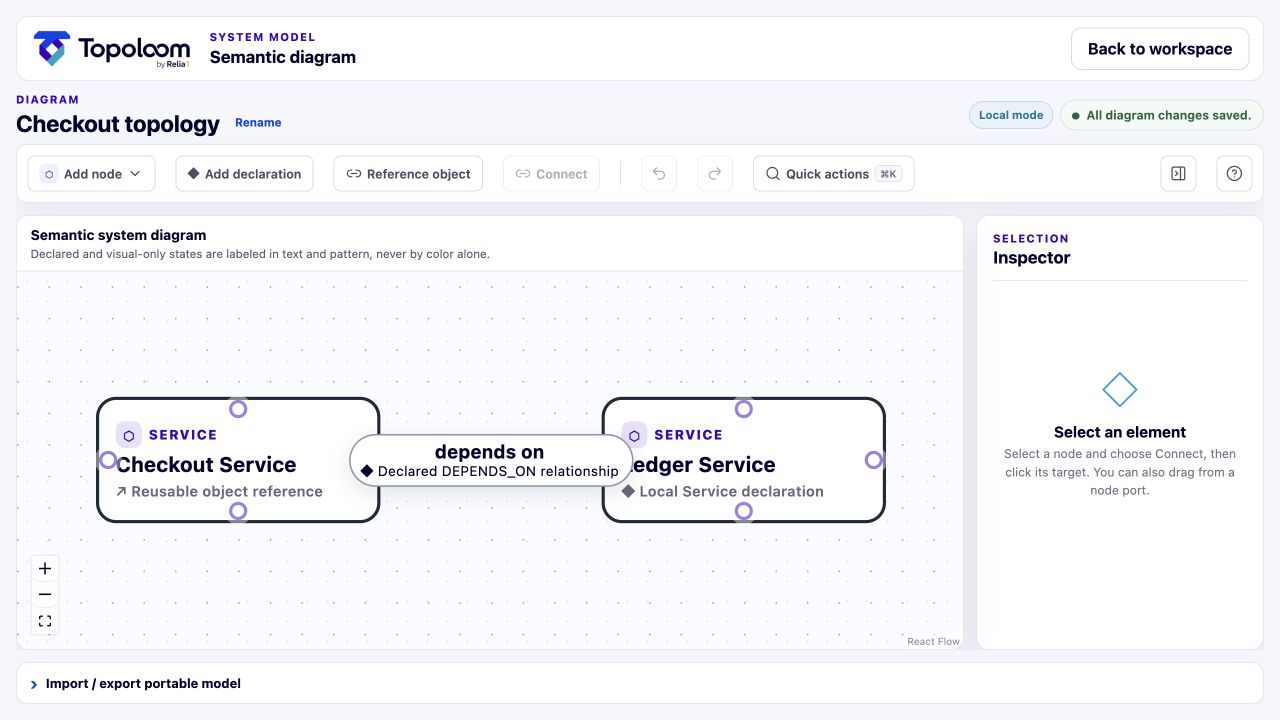
Semantic diagrams
Typed objects and declared relationships stay distinct from connectors used only to make a diagram readable.
See how Topoloom connects prose, objects, diagrams, operational knowledge, and review.