Begin with a clear explanation.
Use collaborative documents and structured diagrams as familiar working surfaces.
The platform
Topoloom keeps documents and diagrams readable for people while making important objects, relationships, versions, and changes explicit.
The checkout flow routes authorized requests through Payment Service.
svc.paymentHuman-authored declaration
Everyday authoring
Write, draw, comment, review, search, navigate, import, and export in human-readable working surfaces. Formal structure appears only where it improves reuse or governance.
Progressive formalization
Add structure when it earns its place. Incomplete drafts remain writable; published knowledge becomes precise when the work is ready.
Use collaborative documents and structured diagrams as familiar working surfaces.
The surrounding document remains readable while the important concept becomes explicit.
Suggestions stay suggestions until an authorized person confirms what should enter authored knowledge.
Profiles, documents, diagrams, and operational knowledge point to one stable identity.
Review, provenance, permissions, and portable structure remain attached to the published result.
Product evidence
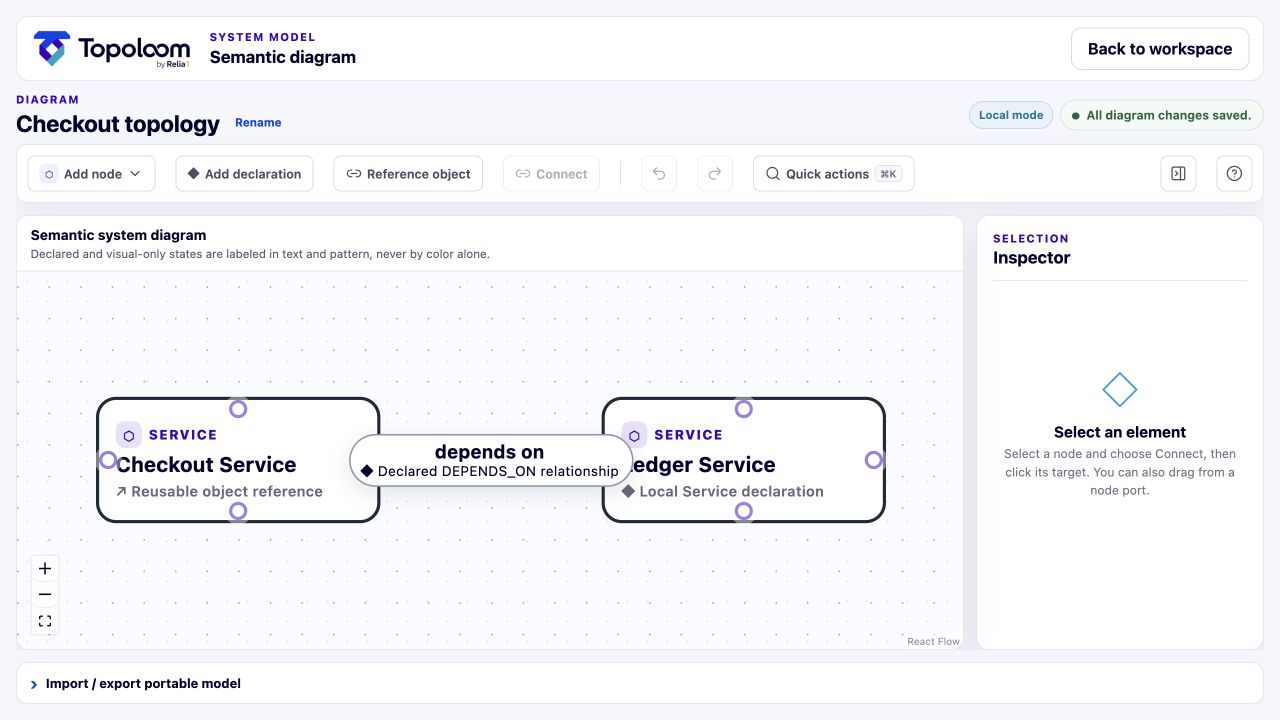
The product keeps every step inspectable. A declared DEPENDS_ON relation carries identity and provenance; a visual-only arrow remains visibly different.
Begin in ordinary collaborative prose.
Preview and confirm the human declaration.
Keep one identity across multiple artifacts.
Give nodes and declared edges durable meaning.
Inspect owner and dependency impact by stable ID.
Apply contracts, retain the trust boundary, and keep a portable package.
Connected by design
Documents, blocks, diagram nodes, objects, references, and human declarations share stable identities without becoming the same kind of artifact.
See an object’s owner, references, diagrams, incoming and outgoing declarations, decisions, and semantic history.
Typed nodes and declared edges carry provenance. Visual-only connectors remain visibly different.
Inspect owner changes, added dependencies, revised objectives, and superseded decisions at their source.
Combine templates with structure, validation, ownership, and review rules at the boundary that matters.
Differences arrive as attributed suggestions. Acceptance creates a normal human-authored declaration.
Readable content, stable IDs, versions, provenance, reviews, and permission mappings move together.
AI-ready without AI dependency
Topoloom produces structured, permission-aware, versioned inputs for search, RAG, GraphRAG, and agents without placing AI in the critical authoring or governance path.
Retrieval can refer to the same object across documents, diagrams, versions, and exports.
Search, references, events, exports, and generated views reauthorize before disclosure.
Consumers can distinguish human declaration, suggestion, publication, supersession, and external context.
Writing, collaboration, review, history, and local export continue when AI or context providers fail.
A focused product walk-through
See the same Service move through prose, a system diagram, a Runbook, an SLO, and semantic review.