
Reusable object
Payment Servicesvc.paymentDeclared Service · Active object
Collaborative knowledge authoringSystem modeling
A Service, such as payment processing, can have one shared record: an object. Reference it from documents and diagrams, then review owner or dependency changes.
Write naturally.Model precisely.Keep knowledge connected.
svc.paymentDeclared Service · Active object
Inside Topoloom
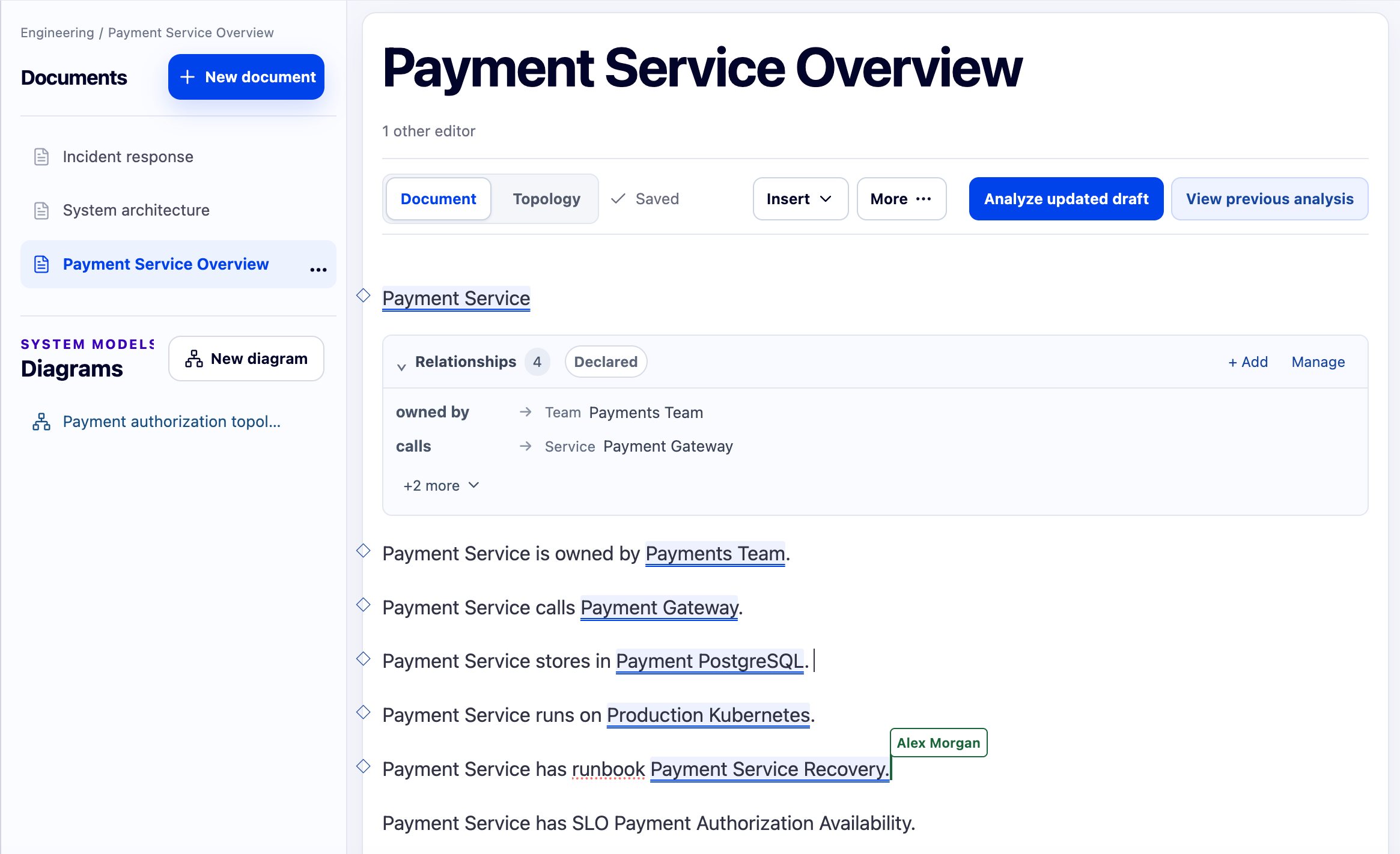
Payment Service is declared inside the prose that explains it. Its relationships stay next to that text, and the document stays readable for everyone who edits it.
The coordination problem
Service descriptions, diagrams, runbooks, and ownership details drift into independent copies. They still look related, but nothing connects them: no shared identity, no record of where each statement came from, and no shared review.
Search tools, human reviewers, and AI systems all read the same material. Each reader needs to know who declared a fact, which version it belongs to, and whether they may see it.
The connected knowledge loop
Start with ordinary prose. Each view below uses the same Payment Service identity, from a declaration in one document to references in a diagram, a Runbook, an SLO, and a review.
Checkout routes authorized requests through Payment Service.
Block 14 · Human-authoredPayment recovery
svc.payment — HAS_RUNBOOK →Checkout objective
svc.payment — HAS_SLO →Core PlatformPayments Team
svc.paymentDeclared Service · Active object
A visible trust boundary
A context provider is an outside system, such as a service catalog. When connected, its findings keep the provider’s name and check time. Only an authorized person can accept a finding as an authored declaration in Topoloom.
Explore trust by designFor technical leadership
Run one Service change through your current tools, then through Topoloom. Count the edits and the review time. Check owner and Runbook coverage and what the export keeps. Include the work to set up and maintain the model.
See the connected knowledge loop
Pick a Service change your team made recently. We’ll take it through Topoloom together and tell you upfront which steps the product supports today.