
From pages to shared facts.
Keep writing readable pages. Turn a repeated fact, such as a Service owner, into a shared object that pages reference. It gets a stable ID and a version history, and its changes go through semantic review.
Why Topoloom
Keep writing readable documents and diagrams. Use a shared object for facts you repeat or review, then see which versions point to it.
The practical difference
Ask these six questions about one change. Each row shows what Topoloom changes and what you can check.
| Current workflow question | With Topoloom | What to inspect |
|---|---|---|
| Where is this owner recorded today? | Reference one Service object | An owner update creates a new object version. Its Used in list shows where the object is referenced. |
| Which diagram links carry meaning? | Declare the relations that matter | A typed edge such as DEPENDS_ON records both ends, where it came from, its lifecycle state, and its version. A line that is only drawn stays visual and declares no relation. |
| What must the reviewer work out alone? | Inspect semantic change | See owner, dependency, SLO, Decision, and lifecycle changes beside the text or diagram edit, instead of reconstructing them by eye. |
| When do publication rules apply? | Check rules only when you publish | Drafts can stay incomplete. When you publish, the built-in Service Overview check requires a Service name, an owning Team, and an approved review. |
| How is outside evidence labeled? | Keep provider context attributed | With a compatible provider configured, each finding shows its provider and observation time. |
| What can the team inspect after export? | Open a scoped package | Open the selected content outside Topoloom and check the export report for anything omitted or transformed. |
Semantic review
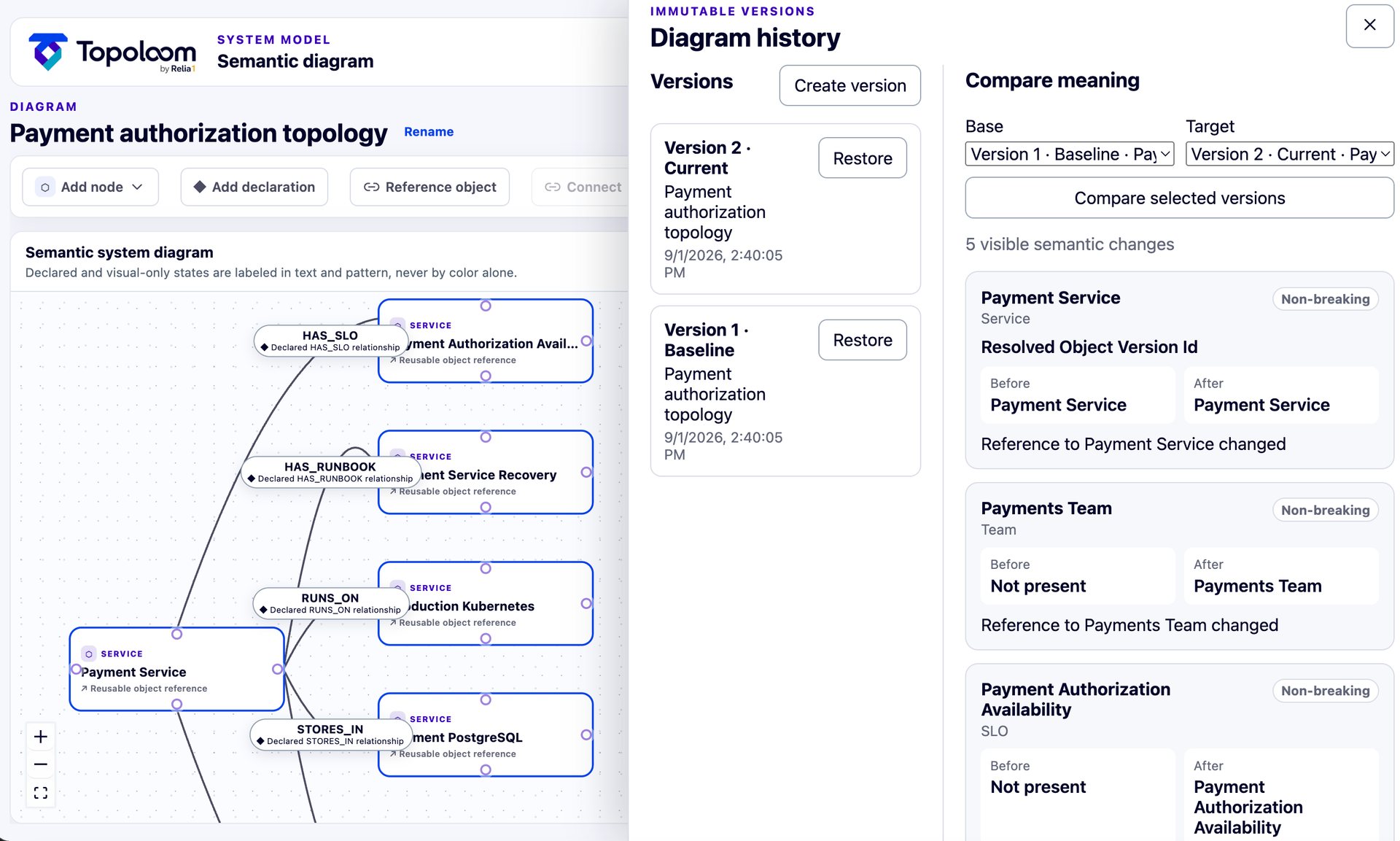
Compare two immutable versions of a diagram. See which references to shared objects changed, not just which boxes moved.
Fits the engineering stack
Use Topoloom to author explanations and model declared relationships. Repositories remain the source for code, monitoring for observed runtime behavior, and catalogs or CMDBs for the records they maintain.
Keep writing readable pages. Turn a repeated fact, such as a Service owner, into a shared object that pages reference. It gets a stable ID and a version history, and its changes go through semantic review.
Keep drawn lines where a picture is enough. Declare a typed relationship only where reviewers need to check what the line means.
Point to source locations and the decisions behind them. Your docs record intent, not the code itself or how it behaves at runtime.
A compatible catalog can link a Service declared in your docs to its own record through versioned APIs and events. The catalog’s data and verification claims stay labeled as the catalog’s. Nothing you authored changes until a person accepts it. Available connections depend on the catalog and your deployment.
Business-case scorecard
Compare the same Service change in your current workflow and in Topoloom. Include setup, a second update, review, and export effort.
How long does a reviewer need to understand an owner, dependency, SLO, or Decision change?
How many places need a manual update when the same Service changes?
Which Services have a declared owner and reviewable provenance?
Which Services have a linked Runbook and SLO?
How much time do setup, creating references, and model upkeep take through a second change?
Can the team open the export without Topoloom and see what it includes and what was left out?
This scorecard is a measurement plan, not a customer result. Record both the benefit and the work Topoloom adds.
Evaluate the difference
In your demo request, describe that fact and one change to it. We’ll confirm the available product scope by email.